Menu
Home
Training course
Downloads
HSP for beginners
HSP Powerpoint presentation
What are HSP?
Why you shouldn’t use Hildebrand parameters
HSPiP eBook, software and dataset package
HSPiP: The eBook
HSPiP: Who should use?
HSPiP: The Software
HSPiP: Datasets, Working Examples, Measurement
HSPiP: Video Tutorials
HSPiP: What is new in the 3rd edition v3.1?
HSPiP: How to Buy?
HSPiP: FAQ
Anomalies of diffusion? No!
Publications
CV
Consulting
Research
Contact

Welcome

Hansen solubility parameters (HSP) have existed since 1967. Their uses have expanded over the years, and include not just classic formulations of coatings but solvent optimization, pigment/nanoparticle dispersions, skin safety, diffusion, stress cracking and more. The appearance of the handbook (Hansen Solubility Parameters: A User’s Handbook, CRC Press, Boca Raton FL, (1999, 2007), broadened the scope of users. Information on this handbook can be found below.

More recently Steven Abbott and Charles Hansen have published an eBook/software/dataset package that is now in its 3rd edition with the help of Hiroshi Yamamoto: 

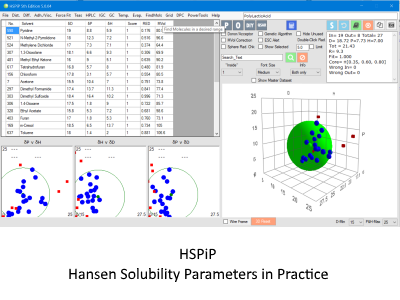
Hansen Solubility Parameters in Practice - Complete with software, data, and examples

The first edition of HSPiP that appeared in November, 2008,  greatly enhanced the usefulness of the Hansen solubility parameters (HSP).

The HSP values of over 1200++ chemicals and 500 polymers are provided in convenient electronic format and have been revised and updated using the latest data sources in the second edition (March, 2009).

A third edition of the HSPiP appeared in March, 2010, with the inclusion of Dr. Hiroshi Yamamoto as an author.  There are now 10,000 compounds in the HSP file which also includes data on density, melting point, boiling point, critical parameters, Antoine constants and much more. The user is able to carry out many different sorts of optimisations of solubility, evaporation, diffusion, adhesion, create their own datasets (automatically if required) and explore the huge range of applications for HSP in coatings, paints, nanoparticles, cosmetics, pharma, organic photovoltaics and much more. Since v3.1.17 2000+ compounds from EAFUS (Everything Added to Food in the United States) have been provided as a significant HSP resource for users.

The 3rd Edition v3.1 was released on 12 December 2010. Current users can upgrade free (now v3.1.21) by downloading the latest .msi installer from the Download page.

Here is what the package can do:

PRODUCT PERFORMANCE
1) Predict chemical resistance of plastics
2) Predict breakthrough times and permeation rates for chemical protective clothing.
Chemical protective gloves are treated in a new chapter with examples for handling cytotoxic chemicals - and for preparing chili sauce
3) Predict ESC resistance (Environmental Stress Cracking)
4) Predict extraction resistance such as permanence of additives
5) Select optimum combinations from datasets on GRAS (Generally Regarded As Safe), Food/Cosmetics, Sigma Aldrich Flavors and Fragrances, Deuterated NMR solvents, Skin Permeation Enhancers and much more
6) Calculate requirements for polymer chain intermingling for optimum adhesion
7) Predict azeotropes and vapor/liquid equilibrium
 
PRODUCT FORMULATION
1) Understand thermodynamics versus kinetics
2) Estimate the compatibility of drugs with carriers
3) Optimize solvent to good, bad or indifferent (boundary)
4) Improve polymer similarity to improve adhesion
5) Predict self-organization (what goes where and why)
6) Improve pigment dispersion stability
7) Control evaporation of solvent blends using a new modeler with absolute time calculations and potential for water condensation during solvent evaporation
8) Help selection of surfactants and to predict their HSP
9) New modeler for polymer solution theory
 
SOLVENTS AND POLYMERS
1) Calculate the HSP for chemicals not listed in the updated 1200+ file by the group contributions methods of Hoy, Van Krevelen, or Stefanis-Panayiotou.
2) Fully automatic calculation of HSP from Smiles or Molfile inputs, including a 3D viewer of the Molfiles. The Y-MB methods for doing this uses Dr Hiroshi Yamamoto’s neural network molecular breaking technique (Y-MB) that is now improved to better handle large molecules and surfactants. In addition it automatically provides UNIFAC groups for the Stefanis-Panayioutou method that previously had to be carried out manually. Neural network estimations of the critical temperature, the critical pressure, and Antoine Coefficients, melting points, boiling points, and refractive index are also provided by the Y-MB method.
3) Environmental data from the Y-MB calculations: Vapour Pressure, RER (Relative Evaporation Rate), Flash Point, Carter MIR, Log(OH) radical reactivity. Smiles matches: Y-MB automatically tells you if the HSPiP database already has your molecule or something very like it.
4) Analog search: Finds molecules in the HSPiP database that contain the functionality (or, if you prefer, the exact functionality) of the molecule you entered into Y-MB.
5) Chi parameter calculations: For your chosen solvent, the Chi parameters for each of the polymers in the database are automatically estimated.
6) Activity Coefficients in IGC: The option to specify data as activity coefficients rather than Chi parameters.
7) Bulk translation of Smiles to HSP via Y-MB.
8) Fully automatic estimation of polymer HSP using "polymer Smiles". Users can choose from a large database of polymer Smiles (including 3D views of the monomer units), create their own, and even create AAAA, ABAB, AABB... monomers for polymer Smiles estimations.
9) Substitute for undesirable chemicals (HAP, FAME, REACH, etc.)
10) Replace an undesired solvent with another
11) Optimize solvent blends to best match the HSP of a target
12) Calculate composition and HSP of solvent blends during evaporation
13 Find the best solvent(s) for a polymer
14) Find extraction solvents systematically
15) Search for polymers compatible with a given target polymer
16) Search for those polymers soluble in a given solvent
17) Search for HSP analogues by Distance (plus boiling point) or functional groups
18) Estimate HSP for ionic liquids
19) How to measure your first HSP
20) Polymer HSP data have been rated for reliability
 
CHEMICAL AND PHYSICAL ANALYSIS
1) An Inverse Gas Chromatography (IGC) analysis enables fully automatic estimation of HSP values of surfactants, oligomers and polymers. This include automatic calculations of Chi from retained volume data. There are 2 methods estimating 2nd-virial coefficients from critical parameter data included with the program. HSP are calculated at the temperature of the IGC experiment and also automatically re-calculated for 25°C.
2) Estimate retention times for HPLC (High Performance Liquid Chromatography) and IGC (Inverse Gas Chromatography)
3) Choose necessary solvents for satisfactory HSP analysis
4) Choose additional test solvents (boundary) for improved HSP analysis
5) Determine the HSP of polymers, Quantum Dots, nanoparticles, microparticles, fibers, and pigments
6) Select mixed deuterated solvents for improved solvency for NMR analyses
7) Predict GCRI (Gas Chromatograph Retention Index)
 
DIFFUSION IN POLYMERS
1) Solve the diffusion equation for constant or exponential diffusion coefficients for a variety of conditions to study the effects of film thickness, diffusion coefficients, etc.
2) Model “Fickian” diffusion for absorption, desorption and permeation
3) Model S-curves for absorption by combining constant or exponential diffusion coefficients with a significant surface condition
4) Model Case II diffusion with an exponential diffusion coefficient and a very significant surface condition
5) Model Super Case II diffusion with an exponential diffusion coefficient and a significant surface condition
6) Predict relative solubility and permeation rates in pervaporation
7) Permeation calculations including breakthrough times, time-lags, and permeation rates, also with a significant surface condition
8) Glove safety estimations (breakthrough times)
9) Evaluate surface mass transfer coefficients from absorption or permeation data
10) Estimate concentration dependent diffusion coefficients from permeation data
 
BIOCHEMISTRY
1) Predict skin permeation rates, including modeling with lag-times
2) Predict absorption into wood
3) Predict synergism of drugs with alcohol
4) Understand the special behavior of chemotherapy drugs including cell membrane permeation and location at the DNA base segments
5) Advance understanding of olfaction - artificial and real noses 

ENVIRONMENT
1) Predict sorption of organic chemicals into soil via the soil-water partition coefficient, Koc
2) Calculate properties (desirable and undesirable) of bio-solvents and bio-polymers
3) Find HAP (Hazardous Air Pollutant) replacements by rational means
4) Understand the dynamics of pervaporation membranes for clean-up applications 
5) Select solvents and/or solvent mixtures with lower environmental impact (GRAS) 
6) Read across capability for evaluating solvent properties (compare two chemicals for their key properties including HSP distance 

ADDITIONAL CAPABILITY
1) Copy tables to EXCEL and figures to Windows or Power Point
2) Utilize 3D graphics or Teas (triangular) plots of HSP data
 
More information and all of this capability can be acquired by clicking on the blue title above or on the figure below.


ISBN: 9780955122026
Publication Date: 
1st Ed.2008, 2nd Ed. 2009, 3rd Ed.2010


Hansen Solubility Parameters: A User’s Handbook, Second Edition 


Cat. #: 7248
ISBN: 9780849372483
ISBN 10: 0849372488
Publication Date: 6/15/2007
Number of Pages: 544

  • Enables scientists to predict molecular affinities, calculate the quantitative effects of intermolecular bonds, and interpret chemical and structural properties
  • Correlates HSP data to properties including swelling, permeation, performance, chiral rotation, selective orientation, and more
  • Presents methodology for predicting solubility behavior of carbon dioxide and other gases at different temperatures and pressures
  • Explains how controlling the solubility of asphalt, bitumen, and crude oils can improve petroleum based products
  • Provides extensive HSP tables which aid in the systematic substitution away of undesired chemicals as required by the EU REACH and similar legislation

Hansen solubility parameters (HSPs) are used to predict molecular affinities, solubility, and solubility-related phenomena. Revised and updated throughout, Hansen Solubility Parameters: A User’s Handbook, Second Edition features the three Hansen solubility parameters for over 1200 chemicals and correlations for over 400 materials including polymers, inorganic salts, and biological materials

The above is from CRC marketing.

My major emphasis is on some of the extras compared with the first edition:

Small structural figures are given for each of the 1200 chemicals (about 860 before) (with help from Hanno Priebe).Amazingly good agreement is found with HSP established 40 years ago for a large number of liquids and those calculated by an independent statistical thermodynamics treatment (Chap. 3 – Panayiotou). There are currently no better solubility predictions by the theories of polymer solution thermodynamics (Chap. 4 - Kontogeorgis).

I finally got a chance to clarify my views on absorption and diffusion in polymers with a chapter showing there are no so-called anomalies if measurable surface resistance and measurable concentration dependent diffusion coefficients are both considered appropriately in the customary diffusion equation.

Perhaps not surprisingly as time goes on, there are perfect data fits for carbon dioxide solubility (Chap. 10 – Williams), DNA and other biological materials, and even for predicting the likelihood of ESC in each of the polymers examined.

Carbon Dioxide Solubility

The practical use established for mixing asphalts from different sources (just like mixing solvents in paints or cleaners) to produce a final mix with controlled marginal compatibility with a styrene/butadiene polymer for road material. Crude oil is not a colloidal dispersion (Chap. 9 - Per Redelius)

The need to match HSP for cleaners and soils, and the problems one has to use the “inert” solvents that do not destroy the ozone layer or have other environmental problems. These are also essentially inert with respect to the soils that must be removed, for which reason azeotropes are suggested for vapor degreasing (Chap. 11 – Durkee).

I will stop with these, recognizing that much has been left out.

The thing that convinced me that something was right here happened some 40 years ago. When I saw that one could predictably mix two non-solvents to dissolve given polymers with about 98% reliability, I knew something was right. There was, and still is, no other way of making such predictions.

Charles


Show all news